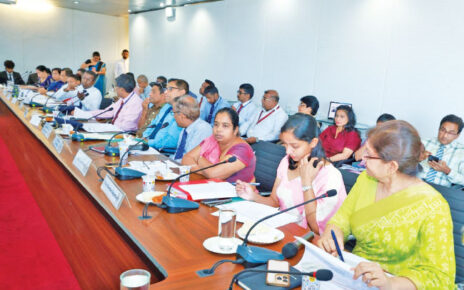
Sri Lanka is restructuring its SME sector by consolidating agencies into a new Industrial Transformation and Innovation Authority (ITIA) to foster a cohesive, export-oriented ecosystem, Chathuranga Abeysinghe, Deputy Minister of Industry and Entrepreneurship Development told the American Chamber of Commerce of Sri Lanka (AmCham) CEO Forum 2026 held in Colombo recently.
The ITIA will be enacted this year and established by 2027. The initiative aims to address critical gaps in financial literacy, capital access and ease of doing business, targeting a $36 billion export goal by 2030 through enhanced, long-term industrial transformation, Delivering the keynote speech, he highlighted that while Sri Lanka has the necessary components for a thriving SME sector, government agencies, NGOs and private institutions are currently disconnected by not being connected to a particular ecosystem and emphasized the need to build a cohesive ecosystem to link these separate entities.
Abeysinghe outlined five core problems and the government’s plan for institutional reform: Firstly, the lack of financial literacy: Many SMEs operate without balance sheets, P&Ls, or an understanding of debt-to-equity, making them unresilient. Secondly access to capital: Current bank financing is too expensive and short-term. There is a desperate need for a development bank and more venture capital for startups, thirdly ease of doing business: operations, trade, and compliance remain difficult and confusing for businesses of all sizes, fourthly growth mindset: businesses focus too much on the limited local market; they need to shift toward global value chains and entrepreneurship and finally lack of innovation: profitable companies often ignore productivity and research. There is very little use of market intelligence to drive product development.
Emphasizing on the Government’s reform plan the minister said they would implement institutional merger: The IDB, NEDA, and CEDD will be merged into a single body called the Industrial Transformation and Innovation Authority (ITIA) by 2027 to create a cohesive ecosystem. They would also look at Capacity Building: A 300 million rupee investment with SLIM is underway to retrain 1,800 ministry development officers to better support innovation on the ground.
Also Simplified Registration will be introduced. A new, harmonized business registration process is being launched to allow businesses to get up and running in just 1-2 days using a single form across all provinces. Measures would also be implemented for regulatory clarity: A national framework is being developed to clear up “red tape” confusion regarding which certificates are needed from different departments (Customs, Fisheries, UDA, etc.).
The minister argued that the term “MSME” is often misunderstood because the needs of each group are different. With regard to big “M” (Micro): Sri Lanka has over a million micro-businesses, but the minister questioned if focusing limited resources here provides the highest impact. He said the tiny “S” (Startups) were often overlooked, this sector is seen as the “high-yield” engine that can truly change the country’s economic trajectory. With regards to the mediums, he said the goal is to scale these 10,000+ businesses to a global level and get them listed on the stock market.
Abeysinghe used three specific figures to set the stage for the 2030 vision: 13.7%: The growth in January 2026 exports compared to the previous year. $36 billion: The ambitious total export target set for 2030 (which is double current levels) and 20%, the current percentage of credit from the financial sector that actually reaches SMEs.
The minister emphasized that true transformation takes time, noting that countries like Vietnam, India, and South Korea took 20 to 30 years to achieve their current status. He warned that while the government is laying the groundwork now, the full results may not be visible until 2035.
Source : Daily News