- SLEA conference on Saturday to chart path to knowledge economy
- SLEA President says investment needed to generate Rs. 1 of GDP has doubled since 1960
- Exports down to 14% of GDP from 26% in 1960; high-tech only 1.7% of manufactured exports
- Calls for aggressive science and technology policy framework
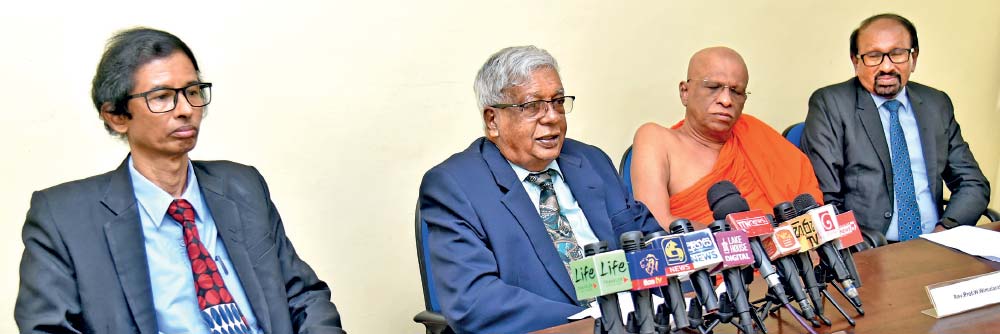
As Sri Lanka grapples with eroding returns on capital, with the investment needed to generate Rs. 1 of Gross Domestic Product (GDP) doubling since 1960, the Sri Lanka Economic Association (SLEA) will hold its Annual International Conference on 21 November under the theme “Paving the Way for Sri Lanka’s Knowledge Economy”, SLEA President Prof. Sirimevan Colombage said yesterday.
“In 1960, if we invested Rs. 3, we could increase our GDP by Rs. 1. In 2025, we have to invest Rs. 6. That means we have to invest more and more to increase income,” Prof. Colombage said, citing the incremental capital output ratio (ICOR), which measures how much investment is needed to generate an additional unit of output. Declining returns on capital were the reason the country must shift to a knowledge economy, he said.
The conference, organised by the SLEA in collaboration with the Gamani Corea Foundation, will be held at the Bandaranaike Memorial International Conference Hall (BMICH) in Colombo. It will bring together local and international economists, policymakers and practitioners to discuss knowledge-driven growth strategies as the country prepares to resume external debt repayments in 2028, following economic stabilisation under the International Monetary Fund (IMF) framework in the wake of the 2022 sovereign debt default.
Prof. Colombage said Sri Lanka’s per capita income was almost on par with Singapore’s in 1960. Today, Singapore’s is nearly $ 100,000, against Sri Lanka’s about $ 5,000.
“Other countries have rapidly developed and achieved upper middle-income and high-income levels. But Sri Lanka is trapped in the lower middle-income range,” he said.
Average growth since 1978 has been around 3.5% to 4%, against more than 8% in fast-growing economies, he said. Sri Lanka achieved 8% growth on only two occasions: after economic liberalisation in 1978 and after the end of the war in 2009. Growth is expected at around 3% to 4% this year, and Central Bank and IMF projections put it at only about 3% over the next three years. Around 22% of the population lives below the poverty line, while the migration of young people is causing a loss of human capital.
Export-led growth, the objective of liberalisation, has not materialised, Prof. Colombage said. Exports as a share of GDP fell from around 26% in 1960 to 14% in 2025. In 1960, exports were sufficient to finance 90% of imports, but by 2025 they covered only 68%.
“We have become more and more inward-oriented rather than outward-oriented,” he said.
Garments still account for nearly 50% of manufactured exports, even as countries such as Vietnam and Bangladesh have opened up their economies. High-tech exports such as microchips and electronics make up only about 1.7% of Sri Lanka’s manufactured exports, against about 30% in South Korea.
“Our export industry is very much basic, I am rather disappointed to say,” Prof. Colombage said.
Citing the World Bank’s 2024 ‘3-I’ strategy, under which a country must pass through investment, infusion and innovation phases to reach high-income status, he said Sri Lanka remained stuck in the investment phase. It had failed to attract the Foreign Direct Investment (FDI) and global production sharing needed to bring in technology from abroad.
“We are rather allergic to foreign direct investment,” he said.
The innovation phase requires heavy investment in research and development and education, but Sri Lanka spends less than 2% of GDP on education, and expectations of raising it to 6% have not materialised, he said.
Prof. Colombage acknowledged that Sri Lanka has fairly strong science and technology institutions, including the National Science Foundation and the National Science and Technology Commission. He pointed to a recent Budget proposal to amalgamate science and technology institutions under one umbrella, as well as digitalisation initiatives.
“Successive governments have not completely neglected this. But we need an aggressive policy framework aimed at promoting science and technology. So far, no government has produced that kind of framework,” he said.
The SLEA, established in 1985 and incorporated by an Act of Parliament in 2011, has more than 900 active members. Since February, it has held two public economic forums and six stakeholder seminars with the Gamani Corea Foundation.
For The international conference, Prof. Colombage said the SLEA chose knowledge economy as a cross-cutting theme spanning agriculture, industry and services, after recent annual sessions focused on each sector.
At the inaugural session, Prof. Colombage will deliver the Welcome and Presidential Address, and Gamani Corea Foundation Honorary Chairman Dr. Harsha Aturupane will deliver the Keynote Address. Australian National University Prof. Premachandra Athukorala will attend as Guest of Honour, and Central Bank Senior Deputy Governor Dr. Chandranath Amarasekara as Chief Guest. Prof. Athukorala’s book ‘Global Production Sharing and Trade Patterns’ will be launched at the session.
Six parallel academic sessions will follow, exploring digital infrastructure, human capital and the labour market, micro, small and medium enterprises (MSMEs), green knowledge systems, institutional governance and intellectual property.
Source: Daily FT