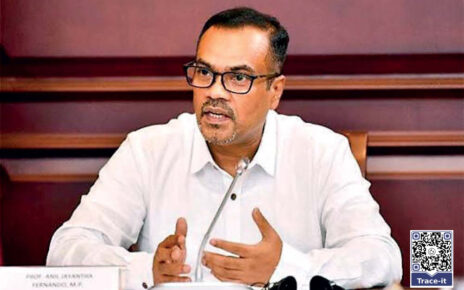
Sri Lanka President Anura Kumara Dissanayake presented his government’s third fiscal blueprint as the island nation’s finance minister, eyeing “economic transformation” from hard-gained stability under an IMF deal.
The budget seeks to capitalize on hard-won macroeconomic stability.
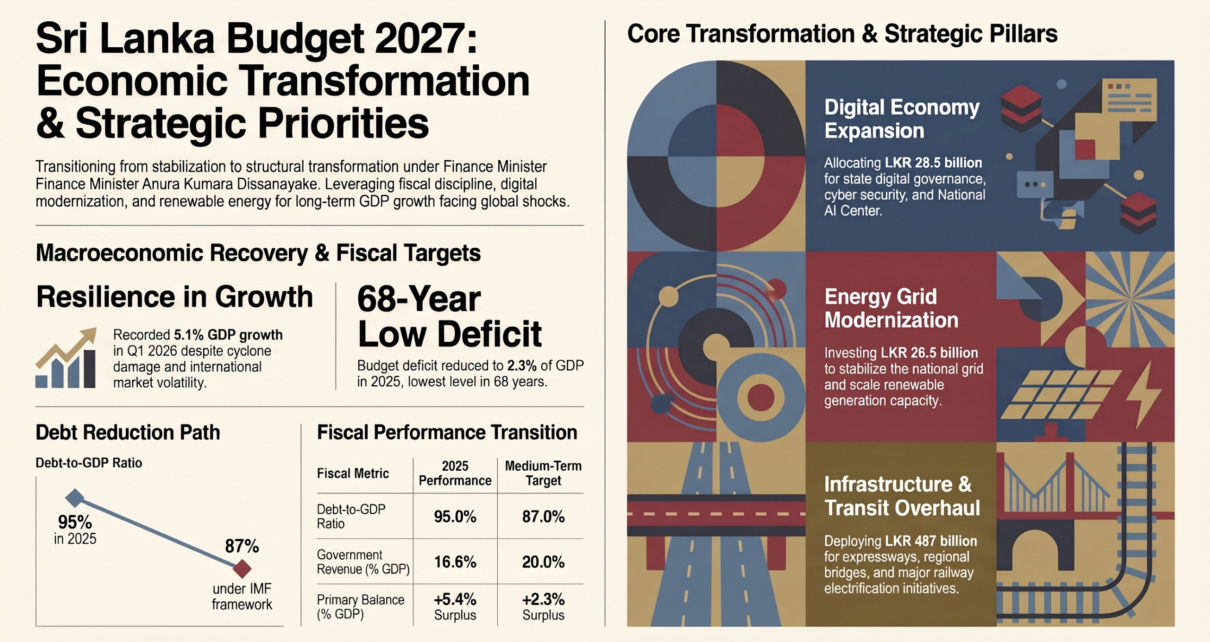
Over the past two years, Colombo focused on plugging massive revenue leaks such as overhauling the Simplified Value Added Tax (SVAT) system rebuilding foreign exchange reserves past the $7 billion mark and securing a Fitch credit rating upgrade to ‘B-‘.
With worker remittances projected to hit a record $9 billion, the Treasury is now loosening fiscal constraints to target a medium-term growth rate of 7 percent or higher.
Despite the ambitious spending push, the government projects state revenues of Rs. 4.99 trillion against total expenditure of Rs. 7.19 trillion, yielding a budget deficit of Rs. 2.2 trillion.
The budget maintains that the fiscal plan remains strictly anchored within the statutory limits of the Public Financial Management Act (PFMA), preserving a primary budget surplus target of 2.3 percent of GDP while keeping public debt on a downward trajectory toward the IMF benchmark of 87 percent by 2032.
For ordinary citizens and salaried workers battered by years of inflationary pressure and steep tax hikes, the 2027 budget delivers some relief.
The annual personal income tax-free threshold has been raised from Rs. 1.8 million to Rs. 1.95 million, effectively exempting monthly salaries of up to Rs. 162,500 from income tax.
Simultaneously, the top marginal tax rate of 36 percent will now apply only to annual earnings exceeding Rs. 5.2 million, up from Rs. 4.3 million previously.
To further cushion household budgets against rising living costs, the government exempted printed books and exercise books from Value Added Tax (VAT) and slashed Special Commodity Taxes on essential imported food staples like sprats and Maldive fish.
Vulnerable demographics also received heightened state support, with Rs. 230 billion allocated for the Aswesuma welfare scheme and monthly allowances for kidney patients and persons with disabilities raised by Rs. 2,500 to Rs. 12,500.
In the public sector, the Treasury committed Rs. 110 billion to finance the final phase of base salary revisions alongside upgraded allowances for health workers, field officers, and university academics.
SME Boost
Domestic entrepreneurs and small and medium enterprises (SMEs), which form the backbone of Sri Lanka’s rural economy, stand to gain from aggressive state-backed credit interventions.
The government earmarked Rs. 67.7 billion in interest subsidies and refinancing mechanisms to channel Rs. 174 billion in concessional loans, carrying interest rates between 3 and 5 percent through commercial banks.
These credit lines target SMEs, women-headed households, rural agro-enterprises, and the fisheries sector.
On the external front, the administration is moving aggressively to dismantle bureaucratic red tape and attract foreign direct investment (FDI).
A 100-percent Treasury-owned investment promotion company and a dedicated officer committee will be established to fast-track state land allocations for strategic commercial ventures.
Board of Investment (BOI)-approved export manufacturing and tourism projects exceeding $3 million will benefit from a 200 percent enhanced capital allowance.
Colombo is also opening major commercial pipelines to international private capital, including four offshore oil and gas exploration blocks in the Mannar Basin, public-private partnerships for the Sapugaskanda refinery expansion, port logistics terminals, and green energy transmission lines.
In a bid to boost hospitality competitiveness, the burdensome Tourism Development Levy will be abolished entirely starting April 1, 2027.
Downward Risks
Yet beneath the pro-growth optimism lie formidable macroeconomic and political risks that could test the Treasury’s projections.
Chief among them is the approaching expiration of Sri Lanka’s four-year IMF Extended Fund Facility (EFF) in March 2027.
With geopolitical conflicts in the Middle East driving the nation’s fuel import bill past $4.4 billion in 2026 and potential El Niño weather disruptions threatening domestic agriculture, President Dissanayake announced the formation of a special Cabinet committee to evaluate entering a successor IMF program.
Maintaining investor confidence once the current bailout framework concludes remains a delicate political balancing act.
Revenue mobilization presents another critical vulnerability.
Tax concessions and duty removals embedded in the 2027 budget including personal tax adjustments, CESS removals, and VAT exemptions will cost the state nearly Rs. 29 billion in foregone revenue.
To prevent fiscal slippage, the government is betting heavily on digital tax administration, including the newly launched National Single Window and automated customs systems, to capture informal economic activity.
The success of Sri Lanka’s 2027 budget eventually hinges on state execution.
While the Treasury has allocated a record Rs. 487 billion for highways, railways, and post-cyclone disaster recovery, historical capital budget utilization rates have frequently languished between 54 and 76 percent due to legacy procurement bottlenecks.
Analysts say enacting pending legislative reforms including the Public-Private Partnership Bill and a modernized Customs Ordinance will determine if President Dissanayake’s government could spend the Rs. 2 trillion fiscal push translates into a lasting economic renaissance.
Economy Next