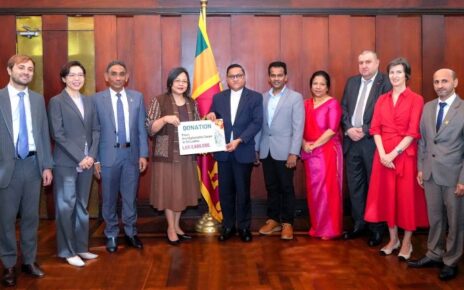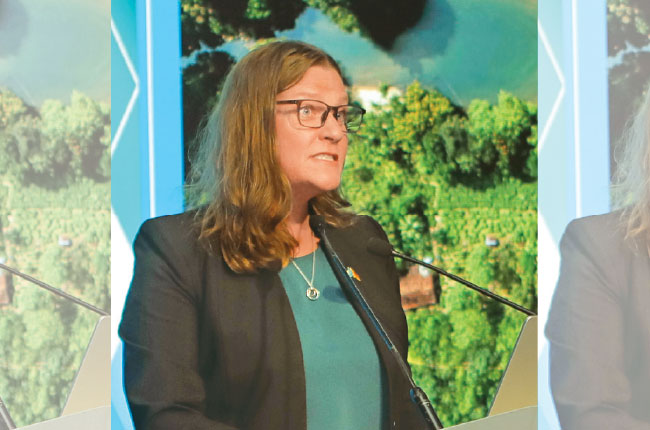
The Asian Development Bank (ADB) is supporting the Sri Lanka Upper Watershed Ecological Restoration Program (SUWERP) to strengthen institutions, mobilize sustainable financing and scale up ecological restoration, Shannon Cowlin, Country Director for Sri Lanka, ADB told the Serendipity Knowledge Program ‘Investing in Sri Lanka’s Upper Watersheds: Unlocking Natural Capital for a Resilient Future’ held in Colombo on August 13.
Cowlin said the ADB commissioned two complementary studies to strengthen the evidence base for future action. The hydrological assessment undertaken by International Water Management Institute (IWMI) has deepened the understanding of the contribution of upper watersheds to water security, climate resilience, and ecosystem functioning.
The economic valuation study examines the value of water and ecosystem services and explores how natural capital can be incorporated into investment and financing decisions. Together, these studies move the discussion from understanding the importance of upper watersheds to identifying practical pathways for investing in them. Globally, countries increasingly recognize nature as productive infrastructure and natural capital investment as a source of economic, social, and environmental returns.
She said discussions around the proposed climate action and nature-positive investment fund or canopy fund also reflect growing recognition that protecting natural capital requires innovative and sustainable financing. These ideas are still at an early stage and new institutional or financing mechanism will require broad consultation, strong stakeholder ownership, and careful consideration of community interests.
Cowlin also noted that Blended finance, payments for ecosystem services, watershed funds, and nature-positive investment platforms are helping mobilize restoration resources at a scale that traditional project financing alone cannot achieve. The proposed Sri Lanka upper watershed ecological restoration program is being developed in response to this opportunity.
Often referred to as the country’s water tower, the upper watershed area supplies water to 23 major river basins and supports water security, food production, hydropower generation, biodiversity conservation, tourism, and climate resilience. These ecosystem services underpin economic activity across the country and support the well-being of millions of Sri Lankans. Yet, these critical landscapes face increasing pressure.
She noted that unsustainable land use, soil erosion, forest degradation, and encroachment have weakened watershed functions and ecosystem services. The impacts of this include higher flood and landslide risks, reservoir sedimentation, lower agricultural productivity, pressure on downstream infrastructure and growing climate vulnerability. Climate change is amplifying these challenges and the impacts are not only felt on the environment, but also by communities that live in and depend on the natural capital in these areas for their livelihoods.
“So, the question before us is not whether the upper watersheds are important. The question is how can Sri Lanka better manage, restore and invest in them to safeguard and preserve the country’s natural capital while bringing benefits and opportunities to the communities living in these areas,” she added.
Cabinet nod for UWMA and Canopi Fund
ADB has agreed to provide the initial funding of USD 100 million for the Canopi Fund and the establishment of the Upper Watershed Management Authority (UWMA), an official from the Finance Ministry said on condition of anonymity. From the government side, the Cabinet has granted approval for the establishment of the fund and authority, he said.
Source : Daily News